
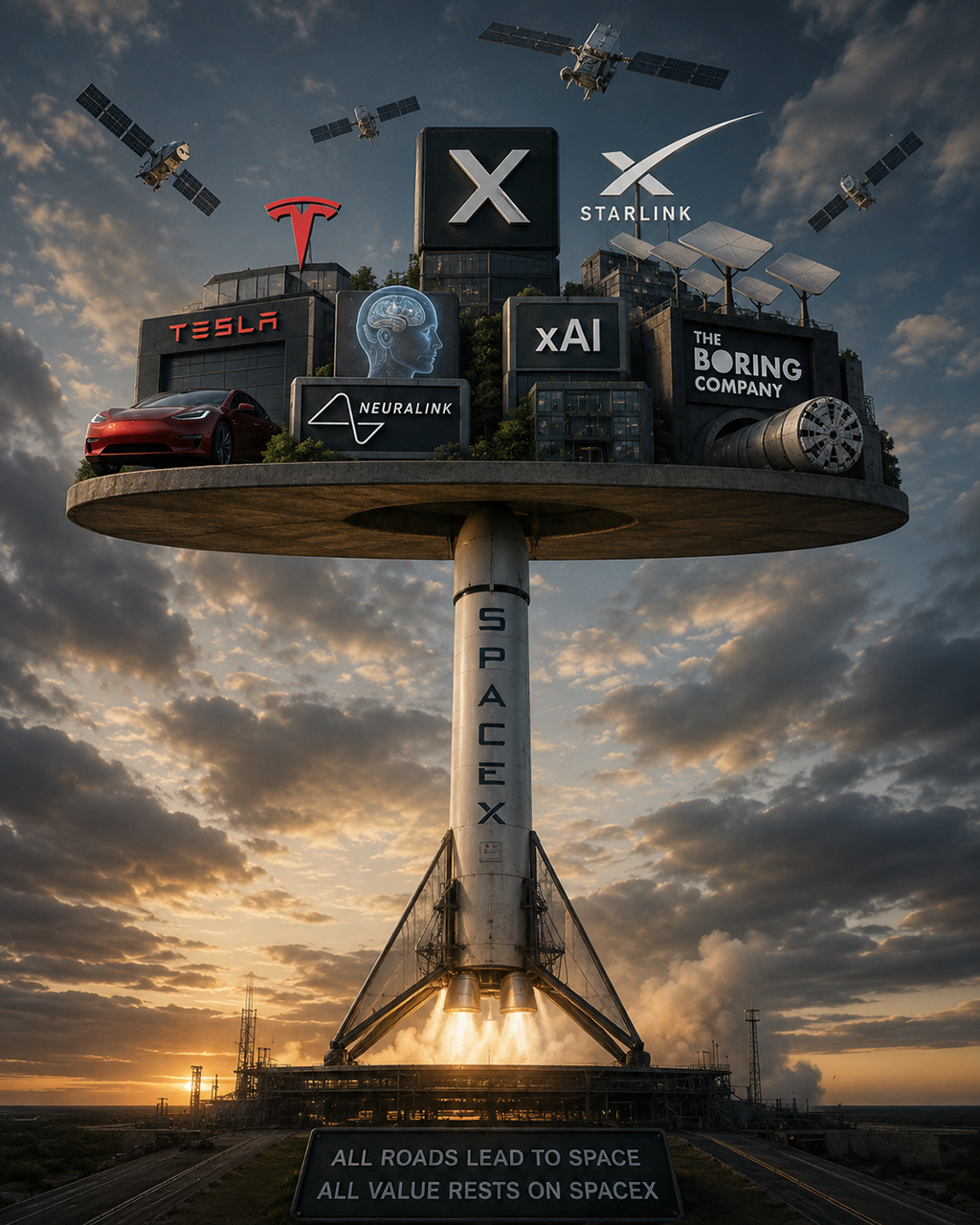
For investors, there is something deeply attractive about consolidation. A collection of businesses becomes a group. A group becomes an ecosystem. An ecosystem becomes a vision.
The story is compelling.
A social media platform feeds an artificial intelligence company. The artificial intelligence company powers new technologies. The space company launches satellites. The satellites support a global communications network. The communications network generates recurring revenue. Every part appears to strengthen every other part.
On paper, the result looks like a masterpiece of vertical integration.
The danger is that what appears to be diversification may in fact be concentration.
Imagine an investor examining such a structure. They see social media, artificial intelligence, satellite communications, launch services, government contracts, human spaceflight, and future ambitions reaching as far as Mars itself. The businesses appear distinct. The revenue streams appear varied. The opportunities seem limitless.
Yet beneath the surface, many of those assets may depend upon a single assumption: that the rockets continue to fly.
This is the risk that markets have never truly tested on such a scale.
Traditional conglomerates spread risk across unrelated industries. A bank, a supermarket, a pharmaceutical company, and an insurance business may rise and fall independently.
Trouble in one division rarely threatens the survival of the others.
The emerging Musk empire is different.
A major launch failure does not merely affect launch revenues.
It can affect satellite deployment.
It can affect network expansion.
It can affect government confidence.
It can affect insurance costs.
It can affect regulatory approvals.
It can affect public perception.
It can affect the valuation of artificial intelligence projects that rely upon the group's infrastructure and financing.
The same event may strike multiple businesses simultaneously.
Investors often comfort themselves by assigning separate valuations to different subsidiaries.
One number for satellites.
Another for artificial intelligence.
Another for social media.
Another for launch operations.
But those valuations are not independent.
If a catastrophic event were to ground launch operations for an extended period, investors would suddenly discover that many of the assumptions underpinning the entire structure were interconnected. The value attributed to one subsidiary could not be isolated from the risks facing another.
The danger grows further when valuations become increasingly dependent upon expectations rather than present earnings.
A company valued on future opportunities can rise spectacularly while confidence remains high. Yet confidence is among the most fragile assets in finance. It can take decades to build and a single afternoon to destroy.
History provides many examples of industries transformed by one unexpected disaster.
Investors are often surprised not by the event itself, but by the speed with which sentiment changes afterwards. Assets that appeared untouchable suddenly face scrutiny. Growth projections are revised. Capital becomes more expensive. Risks that were once ignored become impossible to overlook.
None of this means such an enterprise will fail. It may continue to grow and prosper for decades.
The caution is simpler.
When investors see a collection of powerful assets combined beneath one roof, they should ask not only how the assets strengthen one another, but how they might fail together.
The market has extensive experience valuing banks, manufacturers, retailers, technology companies, and energy firms. It has far less experience valuing a structure in which social media, artificial intelligence, satellite communications, and human spaceflight are bound together by common leadership, common financing, common reputation, and common operational risks.
What appears to be strength may in part be dependency.
What appears to be diversification may in part be concentration.
And what appears to be a fortress may ultimately rest upon a launch schedule.
Investors should remember that a chain is not measured by its strongest link, but by the consequences of its weakest one.